Updated on 5 August 2026
Income Tax Demand 2026: What to Check Before You Pay
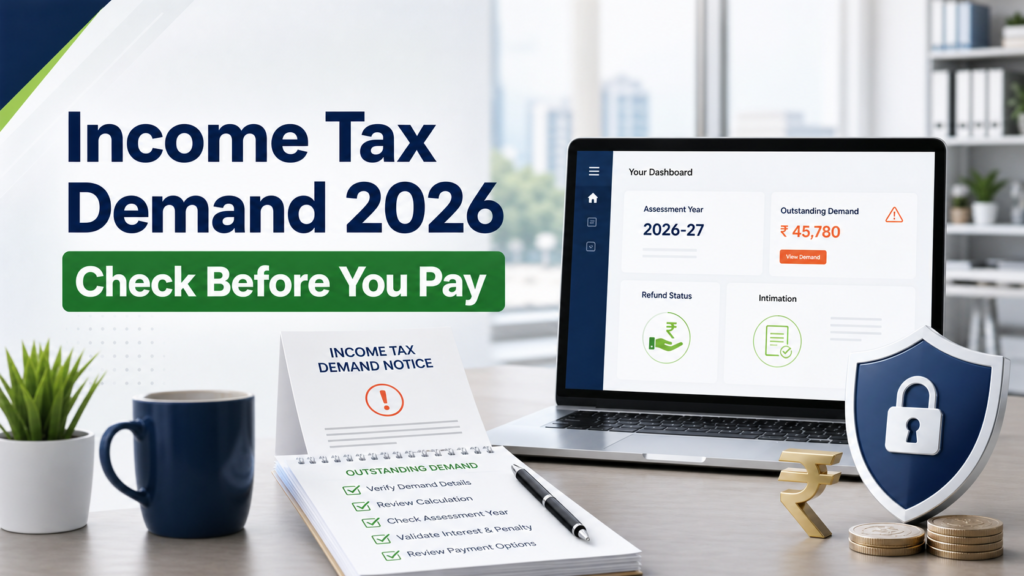
After filing an income tax return, some taxpayers may see an outstanding demand, intimation adjustment or refund reduction on the Income Tax e-Filing portal. Do not panic, and do not pay blindly. First verify the assessment year, tax credit, interest, late fee, challan details and whether the demand belongs to you.
The Income Tax Department e-Filing portal currently highlights the Demand Management Facilitation Centre for taxpayer support on outstanding demand issues. This is useful, but your first step should still be a careful document-level review.
1. Confirm the assessment year and notice details
Check whether the demand relates to AY 2026-27 or an earlier year. Many taxpayers confuse old outstanding demand with the latest return processing. Note the assessment year, section, date of order/intimation, demand amount and portal status.
2. Compare demand with Form 26AS, AIS and TIS
A demand can arise if TDS, TCS, advance tax or self-assessment tax credit is not matched properly. Download the latest Form 26AS, AIS and TIS and compare them with the tax credits claimed in your ITR.
- Check employer or deductor TAN and TDS amount.
- Verify challan date, BSR code, challan serial number and amount.
- Confirm advance tax and self-assessment tax are reflected correctly.
- Check whether any AIS entry needs feedback or clarification.
3. Review interest, fee and tax calculation
Sometimes the difference is not in tax credit but in interest, fee or computation. Review sections such as interest for delay/default, late filing fee, tax regime selection, surcharge, rebate and cess. A small missing income item can also change the final liability.
4. Check whether a rectification or response is needed
If the demand is due to a processing mistake or a mismatch that can be explained, a response or rectification may be more appropriate than immediate payment. Keep the intimation, return computation, challans, Form 16/Form 16A and screenshots ready before taking action.
5. Avoid fake demand-payment links
Use only the official Income Tax e-Filing portal for demand review and tax payment actions. Do not click unknown links received through SMS, WhatsApp or email. Never share OTP, net banking password, card PIN or remote-access permissions with anyone claiming to resolve a tax demand.
Quick checklist before paying a demand
- Identify the correct assessment year and order/intimation.
- Match demand amount with the portal intimation.
- Compare Form 26AS, AIS, TIS and ITR tax-credit claim.
- Review challan details for any payment already made.
- Check whether interest or late fee has been calculated correctly.
- Decide whether to pay, respond, or file rectification based on facts.
FAQs
1. Should I pay an outstanding demand immediately?
Not without checking. First verify the assessment year, tax credit, challan details, computation and whether the demand is correct.
2. What if TDS is missing from the demand calculation?
Compare Form 26AS, AIS, TIS and Form 16/Form 16A. If the deductor has not reported correctly, follow up with the deductor. If the credit is reflected but not considered, review the response or rectification option.
3. Can a refund be adjusted against outstanding demand?
Refund adjustment can happen depending on portal processing and outstanding demand status. Review the intimation and demand details carefully before accepting or disputing any adjustment.
4. What is the Demand Management Facilitation Centre?
The Income Tax e-Filing portal mentions a Demand Management Facilitation Centre to guide taxpayers on outstanding demand issues and grievances. Use the official portal information before contacting or sharing details.
5. Can Quick Efiling Solutions help with demand review?
Yes. Quick Efiling Solutions can review your intimation, Form 26AS, AIS/TIS, challans and ITR computation to help identify whether the demand is payable, disputable or needs rectification.
Need help with an income tax demand?
Quick Efiling Solutions can help review outstanding demand, refund adjustment, ITR processing and tax-credit mismatch issues.
Request a consultation or call +91 9811818306.
Official references:
This article is for general awareness only. Tax demand treatment depends on the order/intimation, facts, records and applicable law.